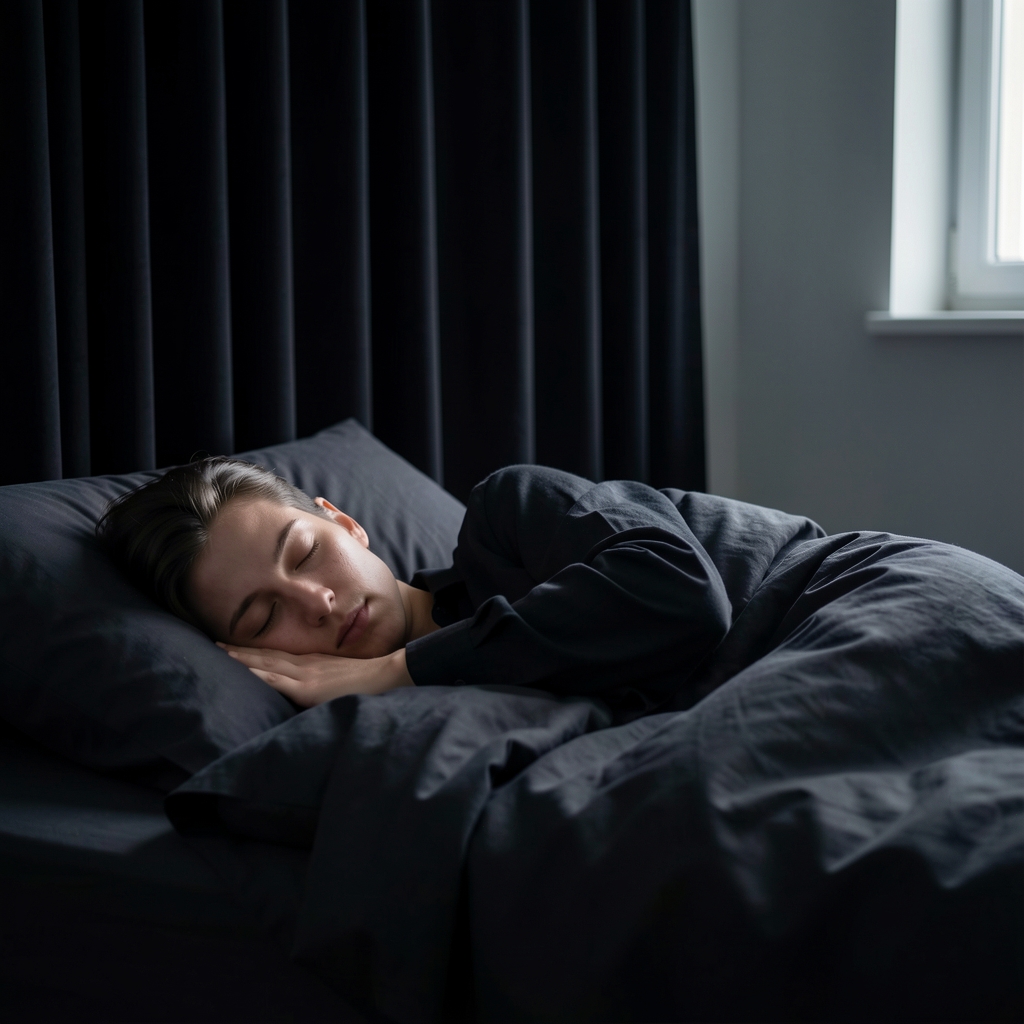
Sleep is not a uniform state. It unfolds across a series of distinct stages, each characterised by different patterns of brain activity, and each associated with different physiological processes. The stages that have received the most attention in the context of body composition are the deeper non-REM stages — sometimes referred to as slow-wave sleep — which occupy a substantial portion of the first half of the night and appear to play a significant role in the body's overnight regulatory activity.
The Architecture of a Night
A typical night of sleep progresses through a series of cycles, each lasting roughly ninety minutes. Each cycle contains a sequence of lighter and deeper stages, culminating — in the earlier cycles of the night — in slow-wave sleep: the stage characterised by the large, synchronised brain waves that give it its name. REM sleep, associated with vivid dreaming and the consolidation of certain kinds of memory, becomes more prominent in the later cycles, toward morning.
This architecture is not merely a description of how sleep feels different at different times of night. It reflects the fact that different physiological processes are time-locked to different stages. Growth-related signalling — which has implications for lean tissue maintenance — is released in pulses that correspond with slow-wave sleep, primarily in the first third of the night. Cortisol, which has implications for energy regulation, begins rising in the early morning hours and is associated with the transition toward wakefulness. The timing of these processes is not arbitrary: it reflects an evolved coordination between the body's internal clock and the physical demands of the sleeping body.
Slow-Wave Sleep and Energy Regulation
The relationship between slow-wave sleep and body composition is not fully understood, but a consistent picture has emerged from the published research. Studies examining the effects of slow-wave sleep restriction — achieved by playing tones during sleep to prevent deep sleep without waking the person entirely — have found alterations in appetite-associated signalling on the following day. Specifically, the signals that convey satiety appear to be reduced, while those associated with appetite and hunger appear to increase.
The practical consequence of this finding, if it holds across the populations studied and the conditions of ordinary life, is that a night with inadequate slow-wave sleep is followed by a day in which the body's energy regulation is, in some measurable respects, shifted toward greater appetite. Over time — and it is the cumulative pattern that matters, not any single night — this shift can bear on energy intake and, by extension, on the composition of the body.
The mechanism appears to involve the regulatory signals associated with energy balance, which are sensitive to sleep quality and duration. These signals operate across a timeframe of hours to days. A single night of reduced slow-wave sleep produces a transient effect; a chronic pattern of shallow sleep, maintained over weeks or months, appears to produce a more durable shift in the body's energy regulatory baseline.
"The cumulative pattern matters more than any single night."
Lean Tissue and the Overnight Recovery Window
Beyond energy regulation, deep sleep appears to have a distinct relationship with the maintenance of lean tissue — muscle and other metabolically active body mass. Physical recovery during sleep — the repair and adaptation of tissue following exertion — is not evenly distributed across the night. It is concentrated in the periods of slow-wave sleep, when growth-related signalling is at its peak.
For individuals who exercise regularly, the implication is that the quality of deep sleep is not merely a determinant of how rested they feel the following day. It bears directly on the extent to which the physical adaptations sought through exercise actually occur. An adequate training stimulus, followed by inadequate slow-wave sleep, is less effective than the same stimulus followed by restorative rest — a finding that has been consistent enough in the exercise science literature to merit serious attention from anyone for whom body composition is a meaningful concern.
This also explains, at least in part, why the relationship between sleep and body composition is not reducible to the question of caloric intake alone. Two people with identical energy intakes and identical activity levels may accumulate different body compositions over time if their sleep quality differs significantly — and specifically if the proportion of their sleep spent in slow-wave stages differs. The body that sleeps deeply is not doing nothing. It is engaged in a set of regulatory and restorative processes that bear directly on its composition.
What Supports Deep Sleep
The conditions that support slow-wave sleep are, to a considerable extent, the same conditions that support overall sleep quality. A cool bedroom temperature, reduced light in the evening, a consistent wake time, and a low-stimulation pre-sleep window all create the environment in which the body is likely to spend adequate time in its deeper stages.
Alcohol is worth specific mention. It is often perceived as facilitating sleep, because it reduces the time to sleep onset. But it does so at a cost: the metabolism of alcohol during the night disrupts the later portions of the sleep cycle, reducing REM sleep and, in heavier use, slow-wave sleep. The night after drinking may feel like sleep, but it is systematically shallower than it would otherwise be.
Sustained physical activity — in particular, regular cardiovascular exercise — is one of the more consistent supports for slow-wave sleep in the published literature. The relationship is bidirectional: exercise supports deep sleep, and deep sleep supports physical recovery. This feedback loop is one of the more compelling arguments for approaching sleep and physical activity as a single system rather than two separate concerns.
- Slow-wave sleep is concentrated in the first third of the night and plays a key role in physical recovery.
- Reducing slow-wave sleep produces measurable changes in appetite-associated signalling the following day.
- Growth-related signalling that supports lean tissue maintenance is released during slow-wave sleep.
- Alcohol reduces sleep quality despite reducing sleep onset time — it shortens slow-wave duration.
- Regular physical activity is one of the most consistent supports for slow-wave sleep in published research.
Observing the Pattern Over Time
The relationship between deep sleep and body composition is not one that reveals itself in a single night or even a single week. It operates across the timescale of weeks and months. This is partly why it has been underappreciated in the popular account of body composition, which tends to focus on the more tractable and immediate variables of food intake and exercise.
A sleep tracking journal, maintained consistently over several months, can make this relationship visible in personal terms. The journal will not measure slow-wave sleep directly — that requires laboratory instruments. But it will capture a proxy that is, for practical purposes, informative: subjective sleep quality, morning alertness, and the relationship between these and the day's energy regulation. People who maintain such records over sufficient time consistently report that they can identify the conditions under which they sleep most deeply — and the downstream effects, felt in appetite, energy, and physical performance, that follow.
The connection between sleep and weight patterns is, in the end, not a simple causal chain but a set of interacting processes that operate across multiple timescales. Slow-wave sleep is one node in this system — significant, well-documented, and unusually amenable to influence through the ordinary adjustments of how a night is arranged.